Recycling & Sustainability for Removal Companies
 As a leading removal company committed to environmental responsibility, we set out a clear sustainability roadmap for all our waste removal services. Our mission is to minimise landfill, maximise reuse and recycling, and support local circular-economy projects. Our immediate target is to achieve an 80% recycling and reuse rate across household and commercial clearances by the end of 2026, rising to a 90% diversion rate by 2029. These targets apply to all our removals company operations, from house clearances to office relocations, and are reviewed quarterly to identify improvements and investment needs.
We work closely with local transfer stations and municipal depots to ensure separated streams are handled correctly. Where boroughs operate specific kerbside regimes — for example, separate food waste caddies in some districts and combined mixed recycling in others — our crews adapt to local requirements. This practical approach reduces contamination rates, increases the proportion of material suitable for mechanical sorting and reprocessing, and keeps our waste removal services aligned with council recycling policies.
![A woman with blonde hair, smiling and wearing a white t-shirt, is seated on a light wooden floor in a spacious room with a plain white wall. She is surrounded by several cardboard moving boxes of varying sizes, some stacked behind her and others open or closed around her. In front of her, two children—one girl and one boy—are lying on the floor; the girl has blonde hair and is wearing a white long-sleeved top and light-colored pants, while the boy has dark hair and is wearing a white t-shirt and denim shorts. The scene suggests a house move or packing process, with the boxes possibly containing household belongings, fitting into a home in a residential area near [TOWN] or within the [POSTCODE] area. The environment is well-lit, emphasizing the casual, positive atmosphere typical of a family relocating, with the focus on the preparation or unpacking stage associated with removals services, such as those offered by Removal Companies.](/pub/_photos/removals/f1335775912.jpg) Partnerships are central to our sustainability model. We partner with local charities, social enterprises and community reuse hubs to give items a second life. Timber furniture, working appliances and good-condition mattresses are offered directly to partnered charities; items in need of minor repair are diverted to community workshops and repair cafés. Our removals company teams log donations and transfers, ensuring traceability and clear accounting for our recycling percentage target and reuse statistics.
Partnerships are central to our sustainability model. We partner with local charities, social enterprises and community reuse hubs to give items a second life. Timber furniture, working appliances and good-condition mattresses are offered directly to partnered charities; items in need of minor repair are diverted to community workshops and repair cafés. Our removals company teams log donations and transfers, ensuring traceability and clear accounting for our recycling percentage target and reuse statistics.
Local Transfer Stations, Sorting & Material Flows
Local transfer stations act as critical nodes in our logistics chain. Materials collected during clearances are taken to council-approved transfer stations where they are bulked, sorted and routed to specialist processors. We prioritise facilities that operate on-site separation lines and have established relationships with licensed reprocessors for glass, paper/card, metals, WEEE (electricals), textiles and construction-type inert materials. This prioritisation helps the removals company reduce cross-contamination and improve overall recovery rates.
 In many boroughs, recycling is already highly stratified: paper and card are separated from mixed packaging, food waste goes to anaerobic digestion or composting, and bulky household items are assessed for repair or repurpose. Our teams are trained in local boroughs' approaches to waste separation and are equipped to pre-sort onsite where possible to boost diversion from landfill. We also maintain clear documentation so that clients and local stakeholders can see where materials go and how they contribute to our recycling targets.
To support these flows we operate a transparent materials hierarchy: reduce > reuse > recycle > recover > dispose. This hierarchy informs every house clearance or commercial move and is reflected in our operational checklists. We also maintain a public-facing sustainability dashboard that reports monthly on tonnages diverted, donations made to charities, and performance against our recycling percentage target so that progress is visible and verifiable.
Low-Carbon Fleet, Charity Partnerships & Practical Action
Fleet decarbonisation is a major pillar of our approach. Our low-carbon vans include a growing number of fully electric vehicles (EV vans), plug-in hybrids for longer routes, and Euro 6 diesel units where required for payload and range. Route optimisation software reduces mileage, and telematics ensure efficient driving behaviour. Together these measures cut CO2 emissions from our removal fleet and complement our waste diversion work, making our waste removal services lower-carbon end-to-end.
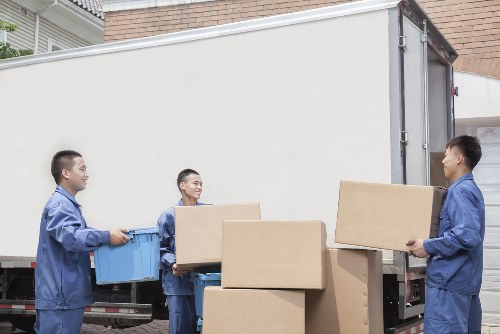 We formalise agreements with local charities and furniture banks so that reusable items are processed quickly and responsibly. Collections destined for charity are pre-notified and scheduled to reduce double-handling. For items that cannot be reused directly, we work with registered recycling partners specialising in textiles, WEEE, metal salvage and timber reclamation. Hazardous streams such as asbestos-containing materials, certain solvents and paint wastes are handled via licensed contractors to ensure environmental safety and legal compliance.
![A woman with long brown hair smiles while holding a medium-sized cardboard box in the foreground, dressed in a white long-sleeved top, standing inside a residential house or flat. In the background, two men are coordinating the unloading of another large cardboard box from the open doors of a white removals van parked outside in a residential street, suggesting an active house move in progress. The scene shows a well-lit, outdoor daylight environment, with the men wearing casual clothing and one of them wearing a cap. The interior space appears clean with a neutral light-colored wall, and the exterior scene hints at a suburban or urban postcode area near [TOWN]. The image communicates professional house removals services provided by Removal Companies, highlighting careful handling of household furniture, including cardboard boxes of various sizes and a wardrobe or large storage containers, within a typical home environment, aligned with sustainability practices on the company’s Recycling and Sustainability page.](/pub/_photos/removals/f1422947320.jpg) Measurement and continuous improvement underpin our sustainability commitments. We publish an annual sustainability statement showing our recycling and reuse rates, the tonnage sent to transfer stations, and the number of items donated to charities and community projects. Our removals company sustainability plan includes staff training, supplier audits, and investment in equipment to improve onsite segregation. We also run pilot schemes with borough councils to trial separate bulky-item pickups for reuse and to coordinate seasonal donation drives.
Measurement and continuous improvement underpin our sustainability commitments. We publish an annual sustainability statement showing our recycling and reuse rates, the tonnage sent to transfer stations, and the number of items donated to charities and community projects. Our removals company sustainability plan includes staff training, supplier audits, and investment in equipment to improve onsite segregation. We also run pilot schemes with borough councils to trial separate bulky-item pickups for reuse and to coordinate seasonal donation drives.
Operationally, our staff receive regular training on local council separation rules — how different boroughs handle glass (separate or mixed), paper/card procedures, and food waste expectations — plus safe handling of electrical items and large furniture. These competencies reduce contamination, accelerate processing at transfer stations, and maximise the salvageable value of cleared items. Our goal is not only to meet the recycling percentage target but to embed sustainable practice across every removal job.
In summary, our combined approach—setting clear targets, partnering with transfer stations and charities, and switching to low-carbon vans—creates a measurable pathway to a circular and low-emissions removals sector. We believe that responsible removal companies can lead the transition to greener, community-focused waste management without compromising service quality or reliability.
The continued success of these initiatives relies on cooperation between local authorities, reprocessors, charity partners and removal firms. By working together, we can ensure that items recovered from clearances are valued, repurposed and recycled — turning what was once waste into a resource for local communities.